In Conversation with Tato Bigio, Co-Founder of UBQ Materials, on Innovation That Turns Waste into Plastic”
To watch the full interview in Hebrew with Tato Bigio Click here<<
Tato Bichou, Co-Founder of UBQ Materials, presents a groundbreaking Israeli technology that makes it possible to transform mixed household waste (without prior sorting) into advanced raw material for the plastics industry. UBQ’s material performs like conventional, petroleum-based plastic, yet is made entirely from waste, significantly reducing landfill and environmental impacts associated with it, while also dramatically lowering greenhouse gas emissions from plastic production.
Tato explains the environmental and economic logic behind the model: processing the “residual” waste that cannot be recycled through conventional means, sharply reducing methane and greenhouse gas emissions, and replacing emissions-intensive plastics with a material that has a very low carbon footprint and even the ability to capture carbon. He also describes commercial applications already in use today across industries such as the automobile industry and food services.
The discussion further touches on regulation, sustainability trends and global markets, the strategic decision to establish a commercial manufacturing site in Europe, and the view of sustainability as a long-term business foundation, and not merely a values-driven agenda.
To watch the full interview in Hebrew with Tato Bigio click here<<
Full Interview
Hi Tato, welcome. UBQ is a company that’s revolutionizing waste treatment, turning it into advanced raw material for the plastics industry. Correct?
That’s right.
Glad I got it right, but it’d be best if you could explain it in your own words.
UBQ is doing something that no one has done before, and frankly still isn’t doing today. We take mixed household waste, where you have food scraps…
Without sorting.
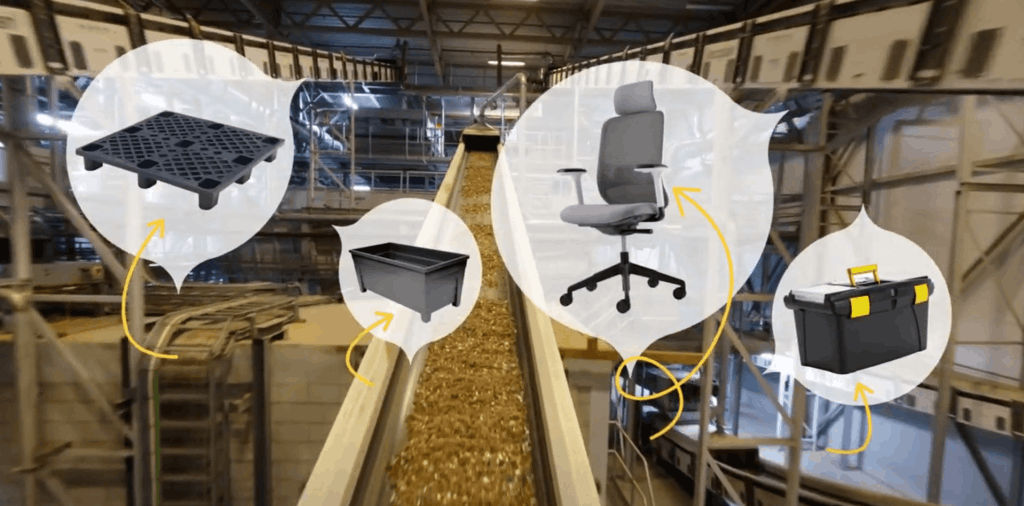
Exactly. Plastics, diapers, organic waste, vegetables – everything that ends up in the trash. Without separating it, we take the entire mass of materials and, through a very efficient and environmentally friendly process, turn it into a thermoplastic material. That means an alternative plastic that can feed the plastics industry with a material that behaves like conventional petroleum-based plastics, except that ours is made entirely from waste!
And it also eliminates the whole complexity of sorting and separate collection streams.
That’s correct. What we mainly do is handle the waste even after someone has already tried to separate it. Even in countries that are very advanced in recycling and sorting, in many cases more than 50% of waste still ends up in landfills. We take that portion. We’re not competing with recyclers, on the contrary.
You’re essentially taking what would otherwise go to landfill.
Exactly. What we call the “residual” waste, and prevent it from being sent to landfill. It’s not just about giving lost materials a second life, but also about preventing the side effects of landfill, leachate (contaminated water from landfills) and methane emissions. Methane is an extremely harmful gas. On top of that, by producing alternative plastic, we replace plastics that are costly both economically and environmentally, because they’re made from petroleum.
And we’ve probably already encountered this plastic in everyday life. It already has applications.
It does. Many industries want to be greener, more circular, reduce emissions, and make use of waste. For example, Mercedes-Benz uses UBQ in car parts, McDonald’s uses it for food trays, even stamped with the UBQ logo.
So many people have probably seen it without realizing.
That’s always the most exciting part. Many companies are already working with us.
And it’s economically viable as well?
Yes. Our process operates at relatively low temperatures, so energy costs are not high. But our biggest competitive advantage is that we don’t pay for our raw material. In fact it’s the opposite – we are paid to take it.
Raw material that usually costs money.
Exactly. Either it’s free, or we’re paid for it. There aren’t many industries like that.
As the saying goes “one person’s trash is another person’s treasure.”
Absolutely.
What’s the real potential here? How much waste can ultimately be turned into UBQ?
Ideally, most waste would be recycled traditionally, for example, PET bottles going back into PET. But we don’t control that. Once waste is mixed together, it’s very hard. The potential is enormous. About 2.5 billion tons of waste are generated globally each year. To put that into perspective, it’s like ten million fully loaded jumbo jets.
That’s terrifying.
There are only about 35,000 airplanes flying worldwide at any given time. That gives you a sense of the scale, and it’s only growing. Plastic alone is approaching 500 million tons annually. UBQ can take all of that waste and turn it into plastic, and there would still be excess waste. So yes, the potential is massive.
You’ve also conducted extensive testing to ensure this is truly sustainable.
Yes. From the start, our goal was to take something environmentally problematic and turn it into something beneficial for both society and the environment. What surprised us was just how positive the impact turned out to be.
Very early on, we began working with Life Cycle Assessment (LCA) methodologies—at a time when LCA was still relatively unfamiliar and challenging, particularly in Israel. In that sense, we were pioneers, not only locally but also globally. Through these early and rigorous LCA analyses, we discovered that the environmental performance of our material went far beyond what we had initially imagined.
Waste emits methane which is 83-86 times more potent than CO₂. When we ran the numbers with leading global firms, we found that every ton of UBQ prevents roughly 11 tons of greenhouse gas emissions over a 20-year period. That’s huge. It doesn’t sound intuitive, but the methane multiplier makes it add up, especially in poorly managed landfills, like most in Israel and elsewhere.
On top of that, we replace conventional plastics. Producing one ton of polypropylene emits around 2.5 tons of CO₂. UBQ emits about 0.15 tons. That’s an entirely different model.
That’s a very strong model.
And then we discovered something else. Because UBQ is made from biological material (mostly food waste and organic matter) we actually capture carbon as well. We have both avoidance and capture. There’s really nothing like it, and it’s entirely an Israeli invention.
After years of strong momentum around sustainability, we’re now seeing some pushback, especially in the U.S., and slower regulation in Europe. Does that affect demand or growth?
We developed our technology in southern Israel, at Kibbutz Tze’elim, with a strong local motivation of developing the periphery. But commercially, Europe made the most sense for our first large-scale plant and that decision looks even clearer today. Despite some political shifts, Europe’s consumer awareness and regulatory environment are very different. Sustainability is still strongly promoted. In the UK, for example, you read not only calories on food packaging, but also emissions.
So we established a large, advanced, robotic facility in the Netherlands, which only started production last year. Demand there is huge, and plastics travel globally anyway. But with such strong European demand, we reduce transportation and serve a broad client base locally.
And there’s plenty of waste.
Plenty of waste, industry, awareness, and regulation – far more than in the U.S. Europeans are clearly leading.
You also mentioned having a dedicated sustainability department, which is unusual for a company at this stage. Why is that so important?
Because today, you can’t hide anymore. Everyone understands regulation is coming, and consumers demand it. Sustainability is no longer optional. If you’re not there, your competitors will move ahead and have a major advantage over you.
In the automobile industry, for instance, Mercedes really impressed me. They could rely solely on their legacy and prestige, but instead they want to lead in sustainability as well. To do that, you need focus. We built a strong sustainability team, and we’re proud to be Israel’s first B Corp-certified company.
That’s really walking the talk.
Exactly. Today, it’s not enough to look good. You need proof, Certifications, verification, real data. Greenwashing is penalized heavily, and companies can lose everything if what they claim turns out to be false.
Many companies are now trying to explain that ESG and sustainability have real business logic. Your example really feels like the future. What’s next?
The path is clear. The EU has committed to net-zero by 2050, with a 90% reduction by 2040, backed by strong public support. Sustainability is also a business opportunity. Sometimes it feels strange to say that, but it’s true. If you’re standing in Home Depot or Walmart and you see a carbon-negative, circular product next to a conventional one at the same price, the choice is obvious. And you go home and tell your kids – that’s UBQ.
Very inspiring. Tato, thank you. Next time, we’ll visit the plant in the Netherlands.
Thank you very much.